
Performance: Epoxy resin adhesive is formulated with epoxy resin plus curing agent, fillers, etc. It has high bonding strength, high hardness, good rigidity, resistance to acids, alkalis, oils and organic solutions, and small curing shrinkage. It can be used as a structural adhesive and building filler for metal, cement, ceramics, glass, stone, wood, thermosetting plastics and other materials. sealing material.
Principle analysis: In the formula, epoxy resin and polyvinyl chloride resin are the main adhesive components; dioctyl phthalate is the plasticizer; quartz powder and white carbon black are the filling modifiers; boron trifluoride glycerin, Boron trifluoride aniline are used as curing agents; phosphoric acid is used as an acidifying agent, which promotes curing and increases the adhesion to metal.
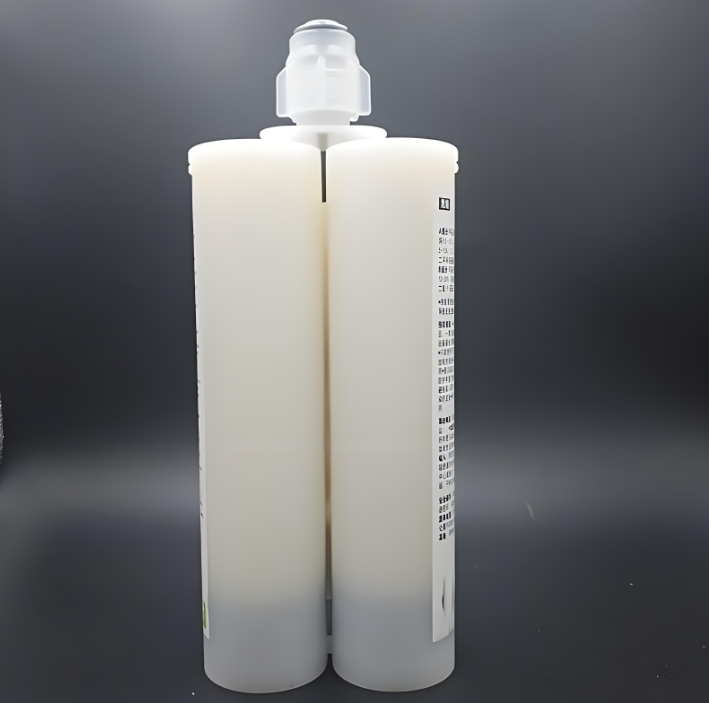
Two-component room temperature curing epoxy adhesive. After applying this product to the bonded surface, apply a certain amount of pressure. Just let it cure at room temperature. The curing conditions are: 14-16 seconds at 16.5 degrees Celsius, 7-9 seconds at 25 degrees Celsius, and 4-6 seconds at 30 degrees Celsius. It is mainly used for bonding various metals and metals, metals and non-metals, and various hard plastic products, with high bonding strength.
1、Using high-performance epoxy resin
Some high-performance epoxy resins, such as AG-80, AFG-90, phenolic epoxy resin, Sipan F epoxy resin, bisphenol S epoxy resin, liquid crystal epoxy resin, TDE-85 (IJ ()), 731, etc., alone or blended with bisphenol A epoxy resin, have high bonding strength. Liquid crystal epoxy resin is a highly molecularly ordered and deeply molecularly cross-linked polymer network that can form a self-reinforcing structure and has excellent mechanical properties. When a small amount of liquid crystal ring maple resin is blended with B144 epoxy resin, the tensile strength and impact strength of the cured product are significantly reduced.
2、Choose enhanced curing agent
The curing agent has an important influence on the bonding strength of the epoxy adhesive. Choose a curing agent that can make the epoxy adhesive have high bonding strength after curing, such as dicyandiamide, m-phenylenediamine, diamino diphenyl methane, and diamino diphenyl. Sulfone, low molecular polyamide (315, 3051), G-328, amino-terminated polyether, 105 amine, methylhexahydrophthalic anhydride, pyromellitic dianhydride/phthalic anhydride (20/28), 2-ethyl- 4. Monomethylimidazole, novolac resin, etc.
The epoxy resin is pre-grafted with CTBN, and polyetheramine (polyetheramine) is used as the internal toughening curing agent. A dual toughening system is used to make the room temperature shear strength of the room temperature curing epoxy adhesive reach 35MPa. 90~ Peel strength exceeds 3.5kN/m.
3、Add reinforcing fillers
The addition of fillers reduces the thermal expansion coefficient and curing shrinkage of the cured product and reduces internal stress. When cracks occur due to overload, the adhesive layer with fillers can also prevent the cracks from expanding, thus improving the bonding strength. For example, epoxy adhesives used for bonding metal structures can increase shear strength by adding an appropriate amount of iron powder. Reinforcing fillers include silica powder, white carbon black, wollastonite powder, alumina, ultrafine aluminum silicate, light oxide oxide, talc powder, sepiolite powder, attapulgite powder, ultrafine calcined kaolin, iron oxide Powder, iron powder, aluminum powder, zinc powder, glass phosphorus flakes, stainless steel flakes, dolomite powder, etc.
4、Inorganic whisker enhancement
Whiskers are fibers with extremely small diameters that grow in the form of single crystals under special conditions. They have a highly ordered atomic arrangement structure and can therefore approach the theoretical strength of interatomic valence bonds. They have great potential for reinforcing epoxy adhesives. . Available whiskers include zinc oxide whiskers, calcium sulfate whiskers, calcium carbonate whiskers, aluminum borate whiskers, titanium-based whiskers, hydroxyapatite whiskers, magnesium hydroxide whiskers, basic magnesium sulfate whiskers, Silicon carbide whiskers, etc.
5、fiber reinforced
Glass fiber, carbon fiber, aromatic polyamide fiber (Kevlar fiber), vinylon fiber, polyvinyl alcohol fiber, polyphenylene sulfide fiber, stainless steel fiber, basalt fiber, mullite fiber, etc. can all reinforce epoxy adhesives.
6、 Silane coupling agent enhancement
Adding an appropriate amount of silane coupling agent, such as KH-560, KH-550, KH-580, KH-590, KH-792, Nanda-42, Nanda-73, A-186, A-1160, etc., can be effective. Improve the bonding strength of epoxy adhesives. For example, the shear strength of epoxy adhesive bonded aluminum with KH-550 (1%) is 11.6.MPa; while that without coupling agent is only 9.7MPa.
7、Use film epoxy glue
Membrane epoxy adhesive is referred to as epoxy adhesive film. Bisphenol A-type solid epoxy resin and multifunctional epoxy resin with high relative molecular weight are often used in manufacturing. The adhesive film can easily ensure a uniform thickness of the adhesive layer during bonding, so the bonding strength is very high.


